

India’s real estate insolvency framework could become more focused on protecting homebuyers, with the Insolvency and Bankruptcy Board of India (IBBI) revising its approach towards project-wise assessment of distressed developments. The proposed framework seeks to distinguish financially troubled projects from completed and financially stable developments within the same developer’s portfolio. This approach could help prevent the financial difficulties of one project from unnecessarily affecting others, while improving resolution prospects and safeguarding homebuyers’ interests.
NEW DELHI : India’s real estate insolvency framework is moving towards a more project-specific approach, offering a potentially important development for homebuyers affected by financially distressed developers. The Insolvency and Bankruptcy Board of India (IBBI) has introduced regulatory changes aimed at improving the treatment of real estate companies operating multiple residential and commercial projects.
According to a report published by The Indian Express on October 31, 2026, the revised framework places greater emphasis on assessing individual projects rather than treating every development of a corporate debtor as an identical financial unit. The changes could have significant implications for homebuyers, lenders, developers and resolution professionals.
The Problem with Multiple-Project Insolvency
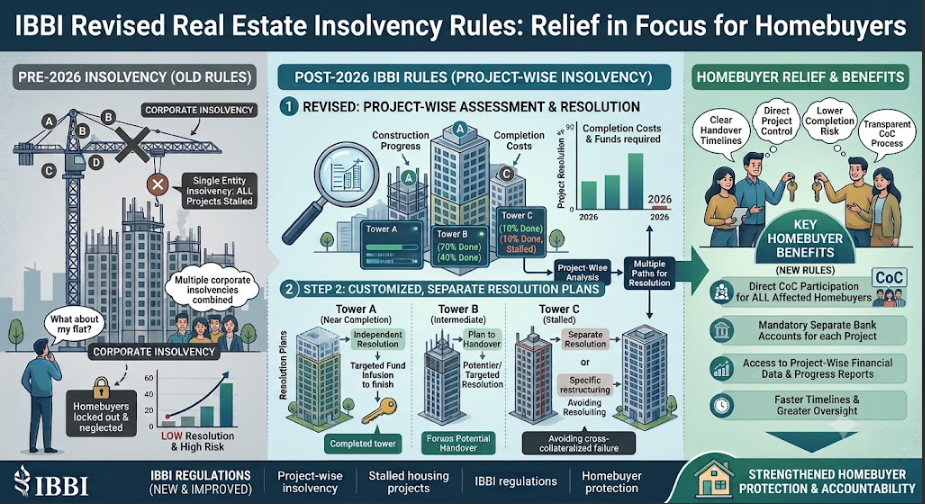
Large real estate companies frequently develop several projects through a common corporate structure. These projects may be located in different cities, operate under different financial arrangements and be at different stages of construction. A developer may have one financially distressed project while other developments are substantially complete or generating revenue.
When insolvency proceedings are initiated against the corporate entity, multiple projects can become entangled in the same resolution process. This can create complications for homebuyers in developments that are otherwise financially and operationally stable. The resulting uncertainty can delay possession, affect asset management and complicate the recovery process.
What Changes Under the Revised Framework?
The revised approach places greater emphasis on project-level assessment by the Resolution Professional.
The assessment is expected to examine important factors such as:
- The actual construction progress of individual projects.
- The remaining cost required to complete each development.
- The financial and operational position of the respective projects.
- The implications of including or excluding completed developments from the insolvency resolution process.
The information is intended to help the Committee of Creditors (CoC) make better-informed decisions regarding the treatment of individual projects. Where legally permissible, the framework provides scope to consider excluding certain completed projects from the insolvency process. This is particularly relevant where a project has reached completion and does not necessarily require the same resolution intervention as a financially distressed development.
Why This Matters for Homebuyers
Homebuyers are among the most vulnerable stakeholders in real estate insolvency proceedings. For many families, purchasing a home involves years of savings, substantial loan commitments and long-term financial planning. When a project becomes stalled because of a developer’s financial difficulties, buyers can face prolonged uncertainty. A more differentiated resolution approach could help identify which projects require immediate financial intervention and which can be dealt with separately.It may also help improve the transparency of project-level financial and construction information.
Will Every Stalled Project Now Be Completed?
The revised framework should not be interpreted as an automatic guarantee that every stalled project will receive funding or be completed. The success of any resolution depends on several factors, including land title, outstanding liabilities, available financing, construction costs, creditor interests and legal proceedings. The exclusion of a completed project from insolvency proceedings would also depend on the applicable legal framework and decisions of the competent stakeholders.
The revised approach is therefore an improvement in the resolution framework, not an automatic settlement mechanism.
What Should Homebuyers Do
Homebuyers affected by insolvency proceedings should maintain access to their allotment documents, payment records, builder-buyer agreements and RERA registration details. They should also monitor developments before the National Company Law Tribunal (NCLT), the Resolution Professional’s communications and decisions of the Committee of Creditors. Where necessary, professional legal advice can help buyers understand their rights and available remedies.
PropertySansar Perspective
The shift towards project-wise assessment could represent an important development in India’s real estate insolvency ecosystem. A more practical resolution framework may help distinguish financially viable developments from distressed assets and protect the interests of homebuyers more effectively. The ultimate measure of success, however, will be whether the revised approach results in faster resolutions, improved transparency and actual possession for affected buyers.


 By



 By