
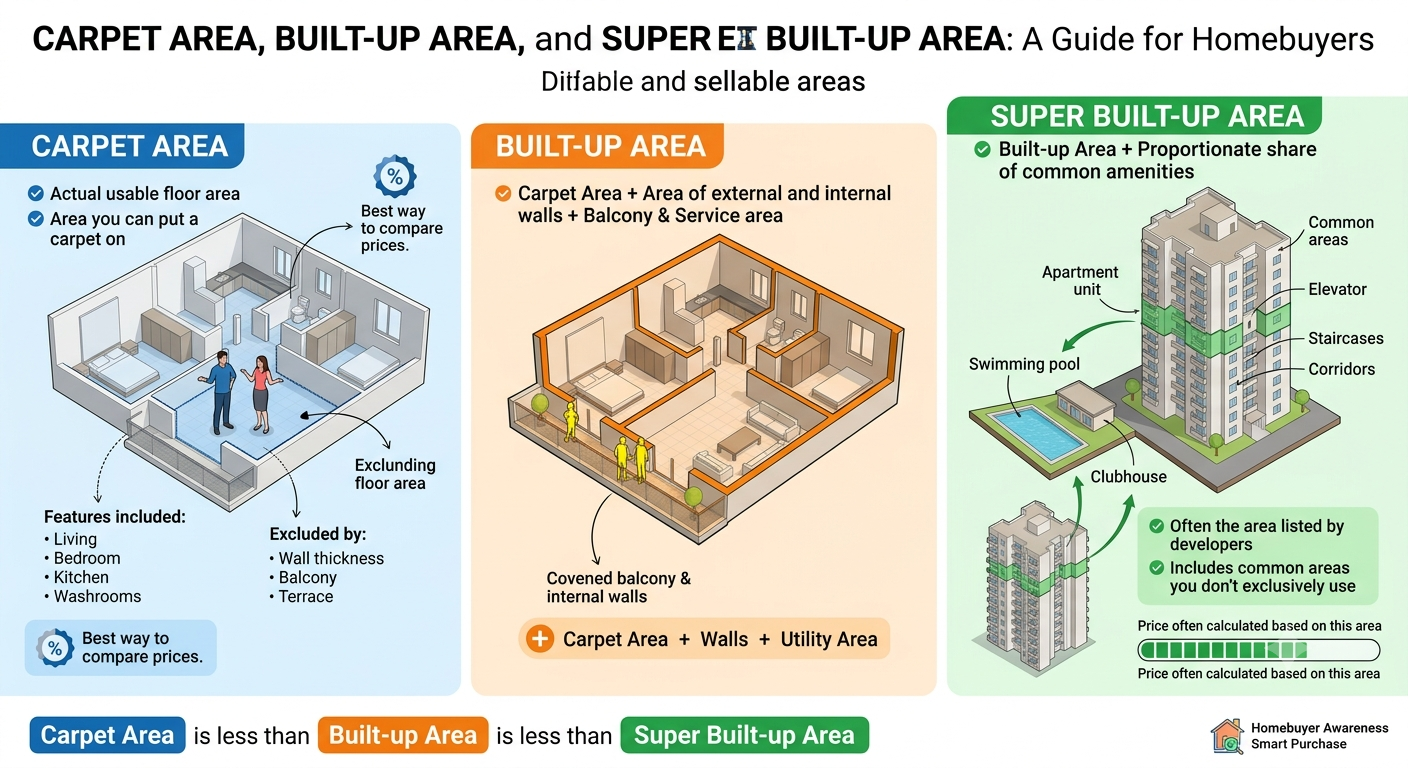


One of the most important aspects of purchasing a property is understanding the area calculations used by developers. While terms such as carpet area, built-up area, and super built-up area are commonly used in the real estate industry, many homebuyers remain confused about their actual meaning and impact on property pricing.
The implementation of the Real Estate (Regulation and Development) Act (RERA) has brought greater transparency to the sector by mandating that residential properties be sold based on carpet area. This has significantly reduced ambiguity and helped buyers make more informed decisions.
Why Understanding Area Calculations Matters
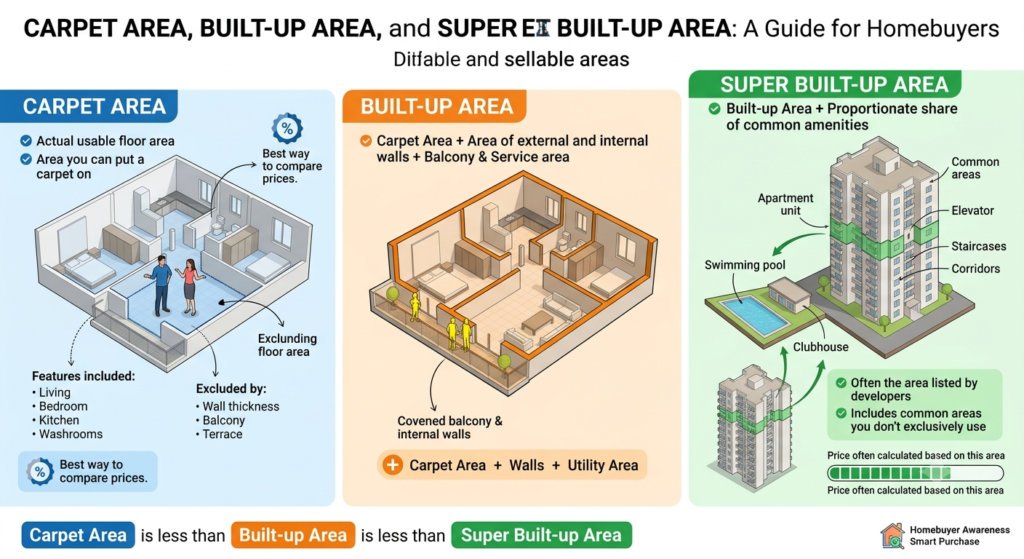
There can be a substantial difference between carpet area and super built-up area—often ranging between 20% and 40%, depending on the project.
For example, a developer may offer two apartments at the same price:
- Apartment A: 1,000 sq. ft.
- Apartment B: 1,200 sq. ft.
At first glance, most buyers may prefer the larger apartment. However, the key question is: which area measurement is being quoted?
If the 1,200 sq. ft. figure represents the super built-up area, the actual usable space inside the apartment could be significantly lower. In many cases, a buyer may end up paying for 1,200 sq. ft. while receiving only around 900–1,000 sq. ft. of usable living space.
Therefore, buyers should always verify whether the quoted area refers to carpet area, built-up area, or super built-up area before finalizing a purchase.
What Is Carpet Area?
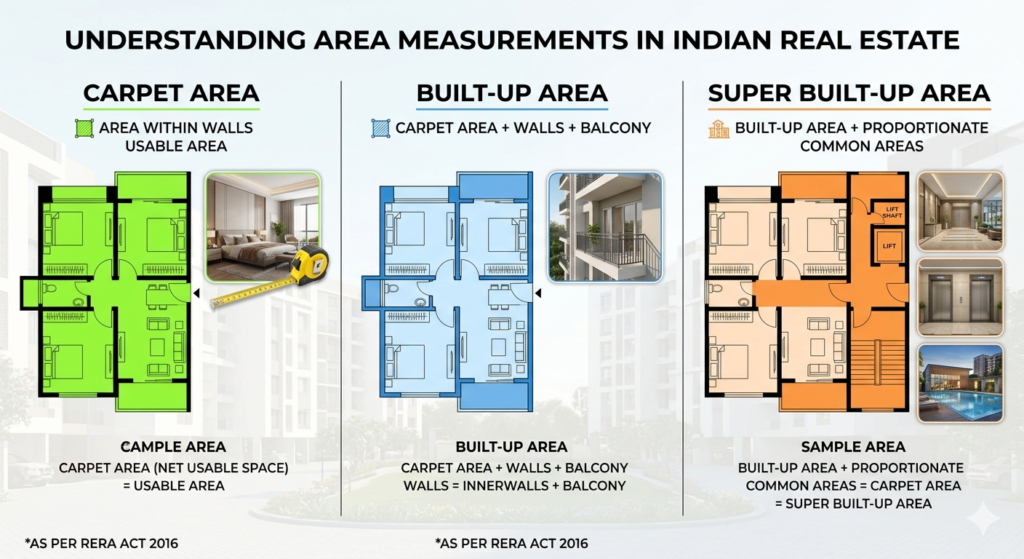
Carpet area refers to the actual usable floor area within the walls of an apartment.
According to RERA, carpet area is the net usable floor area of an apartment, excluding external walls, service shafts, balconies, verandahs, terraces, and other common areas, but including the area covered by internal partition walls.
In simple terms, carpet area is the space where you can actually live, walk, place furniture, and carry out daily activities. It represents the true usable area of a property.
What Is Built-up Area?
Built-up area includes:
- Carpet area
- Thickness of internal and external walls
- Utility areas such as balconies and terraces (depending on project specifications)
Generally, the built-up area is around 10% to 20% larger than the carpet area.
This measurement reflects the total space occupied by the apartment structure, including walls.
What Is Super Built-up Area?
Super built-up area is calculated by adding a proportionate share of common areas to the built-up area.
These common areas may include:
- Building lobby
- Entrance foyer
- Corridors
- Staircases
- Lift areas
- Clubhouse and amenity spaces (where applicable)
- Common circulation areas
Historically, developers often marketed properties based on super built-up area because it resulted in a larger quoted size. However, this frequently created confusion among buyers regarding the actual usable space available inside the apartment.
Common Areas: What Should Be Included?
Industry experts believe that certain infrastructure and maintenance-related spaces should not be disproportionately loaded onto buyers while calculating super built-up area.
These may include:
- Society management office
- Security rooms
- Electrical meter rooms
- Pump rooms
- Generator rooms
- Lift machine rooms
- Underground and overhead water tanks
- Common terraces
- Open storage areas
- Swimming pools
- Utility and service zones
Transparency in the calculation of common area loading remains an important issue for buyers evaluating different projects.
How RERA Changed the Market
Before RERA, there was no uniform standard for pricing residential units. Developers could market apartments based on built-up area or super built-up area, often using different calculation methods. This made it difficult for buyers to compare projects accurately.
Today, RERA requires developers to disclose and sell residential units based on carpet area. This has brought greater accountability and standardization to the sector.
As a result:
- Buyers can compare projects more effectively.
- Property pricing has become more transparent.
- Misleading area representations have reduced significantly.
- Developers are required to provide clear disclosures regarding area calculations.
Tips for Homebuyers
Before purchasing a property, buyers should:
- Ask for the RERA-approved carpet area.
- Understand the difference between carpet, built-up, and super built-up area.
- Review the project’s sanctioned plans and disclosures.
- Verify the percentage of common area loading.
- Compare properties based on carpet area rather than headline size figures.
Conclusion
Understanding the difference between carpet area, built-up area, and super built-up area is essential for making an informed real estate investment. While super built-up area may make an apartment appear larger on paper, carpet area remains the most accurate indicator of the actual usable space available to a buyer.
With RERA promoting transparency and standardization, homebuyers today are better protected than ever before. Nevertheless, carefully reviewing area calculations remains one of the most important steps before signing any property purchase agreement.


 By
By

 By
By