
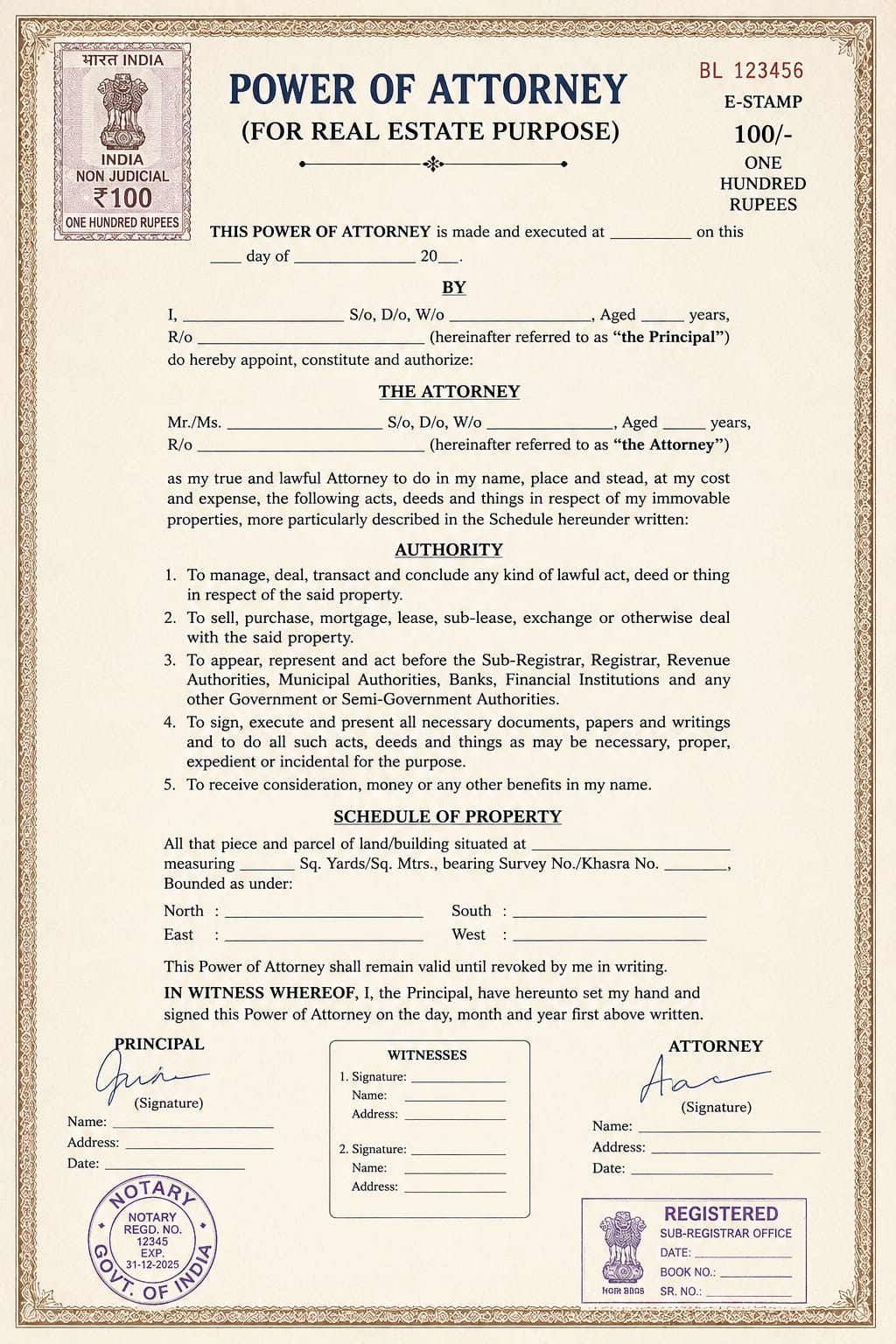

A Power of Attorney (PoA) plays a crucial role in property transactions and asset management. It is a legal instrument that authorizes one person to act on behalf of another in specified financial, legal, or business matters. In the real estate sector, a Power of Attorney is often used when a property owner is unable to personally handle transactions due to distance, health issues, professional commitments, or other practical reasons.
What Is a Power of Attorney?
A Power of Attorney is a legal document through which one person, known as the Principal or Grantor, authorizes another individual, known as the Agent or Attorney-in-Fact, to act on their behalf.
Depending on the powers granted, the authorized person may make decisions related to property management, financial affairs, legal proceedings, or specific transactions. The scope of authority is clearly defined in the Power of Attorney document and must be exercised within those limits.
Since the attorney acts on behalf of the principal, the relationship is built on trust, integrity, and accountability.
How Is It Used in Real Estate?
Power of Attorney is widely used in property transactions. For example, a property owner living in another city or country may appoint a trusted representative to complete documentation, appear before authorities, execute agreements, or manage the sale or purchase of property on their behalf.
The document can also be used for managing rental properties, collecting payments, handling municipal matters, and completing registration-related formalities.
However, it is important to note that a Power of Attorney does not automatically transfer ownership of a property. Property ownership can generally be transferred only through a legally valid and registered conveyance deed, such as a sale deed, gift deed, or other legally recognized transfer document, as per applicable laws.
Types of Power of Attorney
General Power of Attorney (GPA)
A General Power of Attorney grants broad authority to the agent to manage a range of legal, financial, and property-related matters on behalf of the principal.
Special or Specific Power of Attorney
A Special Power of Attorney is issued for a particular purpose or transaction, such as selling a specific property, signing documents, or representing the principal before a government authority.
Durable Power of Attorney
In some jurisdictions, a Durable Power of Attorney remains effective even if the principal becomes physically or mentally incapacitated, provided the document specifically provides for such continuity.
Healthcare Power of Attorney
This type authorizes an individual to make healthcare decisions on behalf of another person when they are unable to do so themselves.
Financial Power of Attorney
A Financial Power of Attorney allows the agent to manage banking, investments, financial transactions, and related matters on behalf of the principal.
Legal Validity and Limitations
A Power of Attorney remains valid only within the scope defined in the document and applicable law. Generally, the authority granted under a Power of Attorney comes to an end upon:
Revocation by the principal;
Completion of the specified purpose;
Expiry of the validity period, if any;
Death of the principal.
In most cases, the death of the principal automatically terminates the Power of Attorney.
A person who lacks the legal capacity to understand the implications of granting authority cannot validly execute a Power of Attorney.
Key Precautions
Before relying on a Power of Attorney in any property transaction, buyers and investors should:
Verify that the document is genuine and properly executed.
Check whether registration is required under applicable law.
Confirm the identity of both the principal and the attorney holder.
Verify that the powers granted specifically cover the proposed transaction.
Ensure that the Power of Attorney has not been revoked or expired.
Obtain independent legal verification before completing the transaction.
Conclusion
A Power of Attorney is an important legal tool that facilitates property management and transactions when the owner cannot act personally. While it provides flexibility and convenience, it should be used carefully and within the framework of applicable laws. Proper documentation, legal verification, and due diligence are essential to ensure that property transactions conducted through a Power of Attorney are secure and legally valid.
Editor’s Note: Property laws governing Power of Attorney transactions have evolved significantly over the years. Buyers should always consult a qualified legal professional and verify the latest state-specific regulations before entering into any property transaction involving a Power of Attorney.


 By
By


 By
By